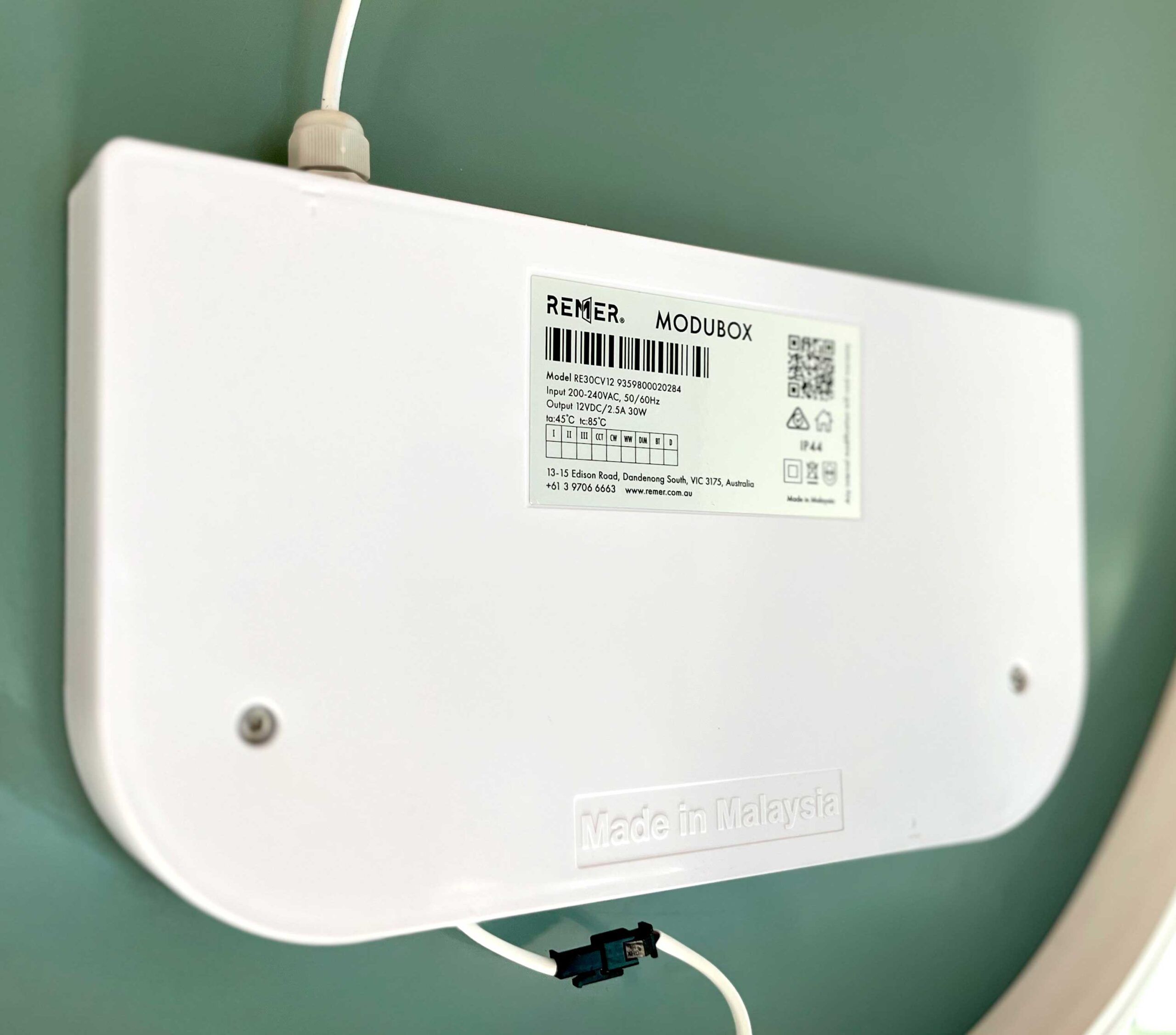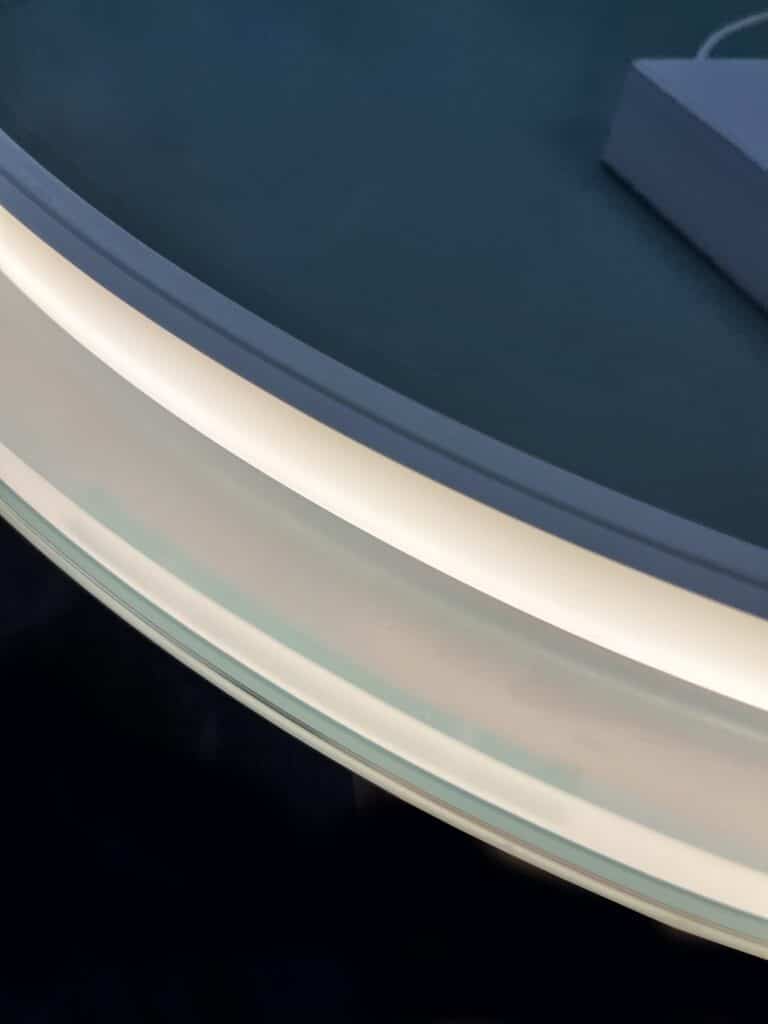
Welcome back to behind the glow, our editorial series exploring the materials, engineering and decisions that shape every Remer LED mirror.
In Episode 1, we explored the ModuBox™ — the system that powers our mirrors from within.
In this episode, we focus on a component that’s rarely seen, yet fundamentally important to performance, lighting quality and design flexibility: LED mirror backing.
Why LED Mirror Backing Matters
Behind every LED mirror is a backing material that performs far more than a supporting role. A well-designed LED mirror backing must:
- support the mirror securely
- maintain flatness and alignment
- house and stabilise LED lighting
- influence light diffusion
- allow for different mirror shapes
- contribute to a clean, refined installation
While often overlooked, the backing plays a defining role in how a mirror performs, how it looks once installed, and how it ages over time.
Common LED Mirror Backing Materials — Pros & Cons
Across the industry, several LED mirror backing materials are commonly used. Each has advantages — and limitations.
EVA Foam Backing
Pros
- lightweight
- flexible
- easy to handle
- cost-effective
Cons
- limited structural rigidity
- can soften or deform with heat
- provides minimal support for LED components
- does not effectively diffuse LED light, often revealing visible LED “dotting”
EVA foam offers flexibility, but can compromise lighting quality and long-term stability — particularly in premium LED mirrors.
Metal Backing Panels
Pros
- strong and rigid
- maintains flatness well
- reliable for mounting hardware
Cons
- heavy
- inflexible, limiting complex or custom mirror shapes
- can visually interrupt installations with darker edges
- less forgiving for continuous LED integration
Metal backings deliver strength, but their rigidity and weight can restrict design freedom — especially as mirror shapes become more architectural.
Introducing Remer’s Seamless LED Mirror Backing
At Remer, we’ve successfully used metal backings for many years. However, as our range is evolving — particularly with the growth of custom mirrors and non-standard shapes and sizes — we have identified the need for a more balanced solution.
The result is our custom-engineered Seamless LED mirror backing.
This material combines the flexibility of foam with the structural integrity traditionally associated with metal — without the compromises of either.
See the Seamless Backing in Action
In the video above, you can see how the Seamless Backing is formed, shaped and integrated with LED lighting — demonstrating its flexibility, stability and clean edge finish across both standard and custom mirror designs.
Flexible Like Foam. Stable Like Metal.
One of the primary reasons for our move to this LED mirror backing is design flexibility.
The Seamless Backing:
- flexes to support curved, arched and organic mirror shapes
- maintains structural stability once installed
- supports LED components without sagging or distortion
- holds mirror flatness over time
This balance allows us to expand our custom mirror offering, without sacrificing performance or longevity.
A Seamless Finish — Designed to Disappear
The defining visual feature of this LED mirror backing is its seamless finish.
Rather than creating a visible edge or dark outline, it:
- blends cleanly into white walls
- creates a continuous, architectural look
- removes visual interruptions at the mirror edge
- enhances minimalist and modern interiors
The backing is designed not to draw attention — but to elevate the finished installation.
LED Lighting Integration Without Visible Dots
Backing material directly affects lighting performance.
Unlike EVA foam, which does not diffuse LED light effectively, the Seamless Backing:
- supports continuous LED strip installation
- works seamlessly with neon flex lighting
- helps eliminate visible LED dotting
- delivers smoother, more even illumination
This is especially important when paired with Remer’s seamless lighting systems, where consistency and refinement define the final result.
Supporting Australian Production
Another key reason for adopting this LED mirror backing is local capability.
The Seamless Backing can be produced and supported through our Australian warehouse, allowing us to:
- bring more production processes onshore
- support faster turnaround for custom mirrors
- strengthen Australian manufacturing capability
- reduce reliance on imported components
This aligns with Remer’s broader commitment to expanding Australian-based production wherever possible.
Additional Benefits — Designed In
Alongside its core advantages, the Seamless Backing also offers:
- lighter weight than metal
- easier handling during installation
- moisture resistance suitable for bathrooms
- stable support for ModuBox™ and internal components
- long-term durability
These benefits complement the backing’s primary role — rather than defining it.
A Thoughtful Evolution in LED Mirror Backing
The move to a Seamless LED mirror backing isn’t about declaring one material “right” and others “wrong”.
It’s about choosing the best solution for:
- refined lighting outcomes
- evolving mirror shapes
- cleaner installations
- local production capability
It’s one more considered step in how we continue to refine what sits behind the glow.
Looking Ahead
In Episode 3, we explore the surface itself — diving into mirror glass quality, reflectivity, flatness and why some mirrors look clearer than others.